





Plain English for a legal product
Clausa’s clients could draft a contract in minutes and then spent days explaining it. One plain sentence beside every clause changed that.
 Freya LundStrategy Director, London
- Kind
- Case note
- Published
- Reading
- 3 min
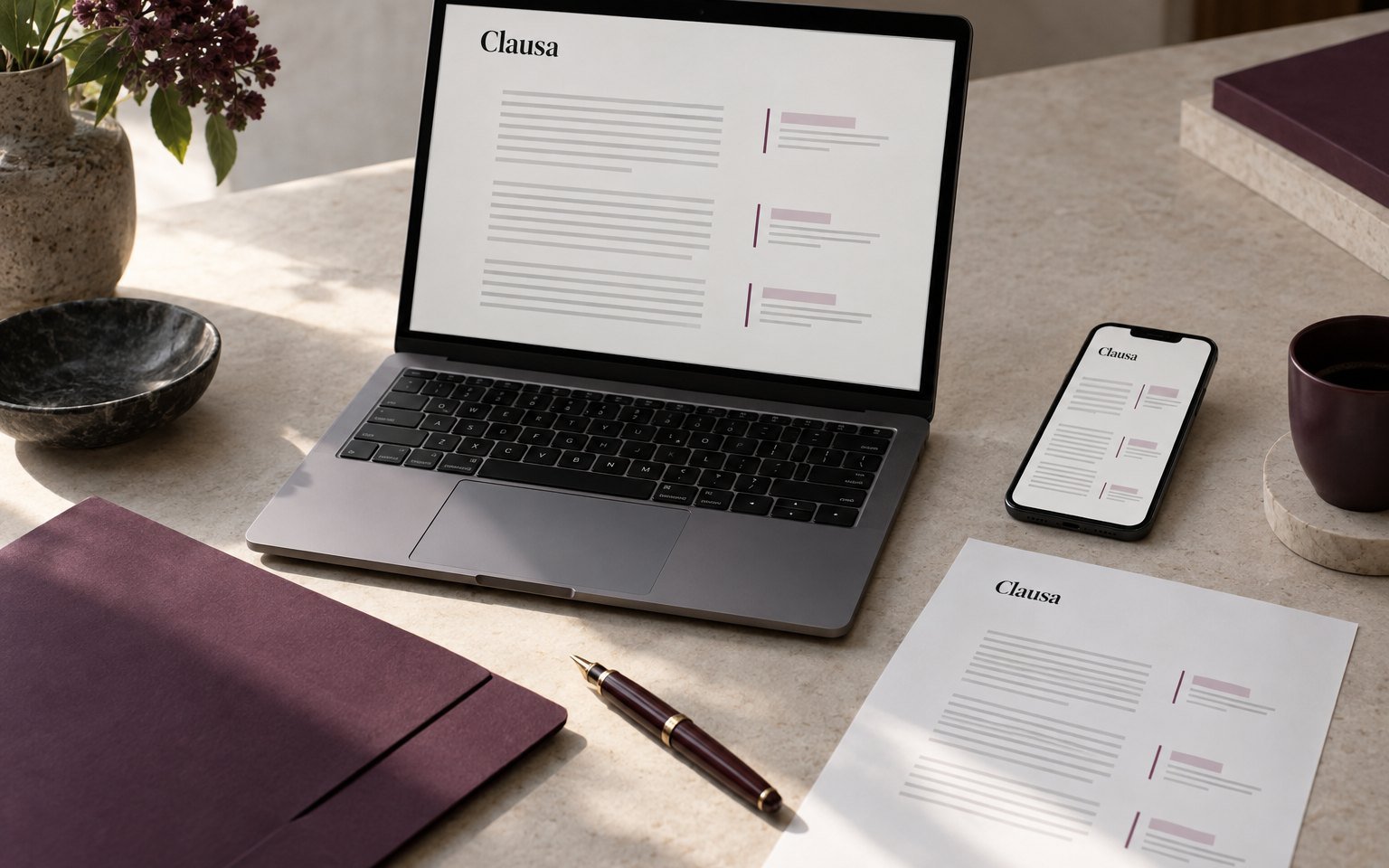
Clausa makes contract software for small law firms, practices of two to twenty lawyers who cannot afford a knowledge team. When they came to us last year they had 260 paying firms and a trial that turned into a subscription only one time in seven. The product worked. In sixteen interviews with partners, nobody complained about the drafting. They complained about what happened after it.
Two readers for every screen
A contract has two audiences. The lawyer reads every clause for what a court would make of it. The client reads it once, usually on a phone, and then rings to ask what it means. Partners told us those calls could take longer than the drafting, and that almost none of them were billed. The product spoke a third language on top of both: engineering. Buttons said “Instantiate template” and “Resolve variable”, because those were the names given to things in the first prototype and nobody had gone back. Lawyers had learned to ignore it. Their clients, who saw the shared draft, had not.
One sentence beside every clause
The idea was small. Each of the 312 clauses in Clausa’s library carries one plain sentence saying what it does to the person signing. On a shared draft the client sees it in the margin, in plum, beside the clause. The legal text itself does not change. Clausa’s two in-house lawyers wrote the first drafts, we edited every one, and a panel of 24 people who had recently signed a contract with a Clausa firm tested them. Each summary followed four rules.
- No more than 25 words.
- Say what the clause does to you, not what it is called.
- No word a reader would need to look up, so indemnify became pay for.
- Never replace the clause, and never soften it: the lawyer’s text is the one that counts.
The last rule mattered most to the partners. Their fear was that a friendly summary would promise something the clause did not. So every summary is reviewed by a lawyer whenever its clause is edited, and the product will not publish a changed clause until it has been.
The clause is written for a court. The sentence beside it is written for the person signing.
Rewriting the buttons
We then went through the interface itself: 470 labels, messages and empty states. “Instantiate template” became “Start a draft”. Error messages now say what went wrong and what to do next. The voice we agreed with Clausa is precise and unhurried, never chatty, because a law firm’s client is often signing something that worries them.
Ten weeks in
The new product and identity launched in January. In the first ten weeks, 31 of the 84 firms that started a trial went on to pay, against roughly one in seven before. Support emails asking what a clause means have about halved. It is early, and a quarter of data proves very little, but the partners we spoke to last month described the same change: fewer calls, and clients who arrive at signing with better questions. We took one lesson for every product we work on. Plain English is not a simpler version of the expert’s language. It is a second layer, written for a different reader, and it needs an owner, rules and a review step like any other part of the product.