

A bottle that sounds like water
We recorded a mountain spring before we drew a single line, then moulded 1.4 seconds of it into the glass.
 Kayode AdebayoMotion Lead, London
- Kind
- Case note
- Published
- Reading
- 3 min
Fontela came to us in the autumn of 2022 with a naturally sparkling spring above Manteigas, a green plastic bottle and a label nobody in the family could remember choosing. Leonor Abrantes wanted the water back in returnable glass and on restaurant tables well beyond the Beiras. My part was meant to be the launch film. It ended up shaping the bottle.
Start with the microphone
Before anyone drew anything, I spent two days at the source with Rafael Couto, a sound recordist, and a hydrophone. The spring rises into a stone basin under a small granite shelter. Underwater it makes a slow pulse, roughly once a second, as gas breaks the surface, over a constant hiss of finer bubbles. Every member of the family could hum it. Nobody had ever recorded it.
We came back with about six hours of sound. In the edit I kept looking for one short phrase that held both parts, the pulse and the hiss, and found it at 1.4 seconds. Drawn as a waveform it was a single, slightly uneven ridge with a long fizzing tail. Tomás put it on the wall next to the bottle sketches, and by the end of the week it had moved onto them.
From waveform to mould
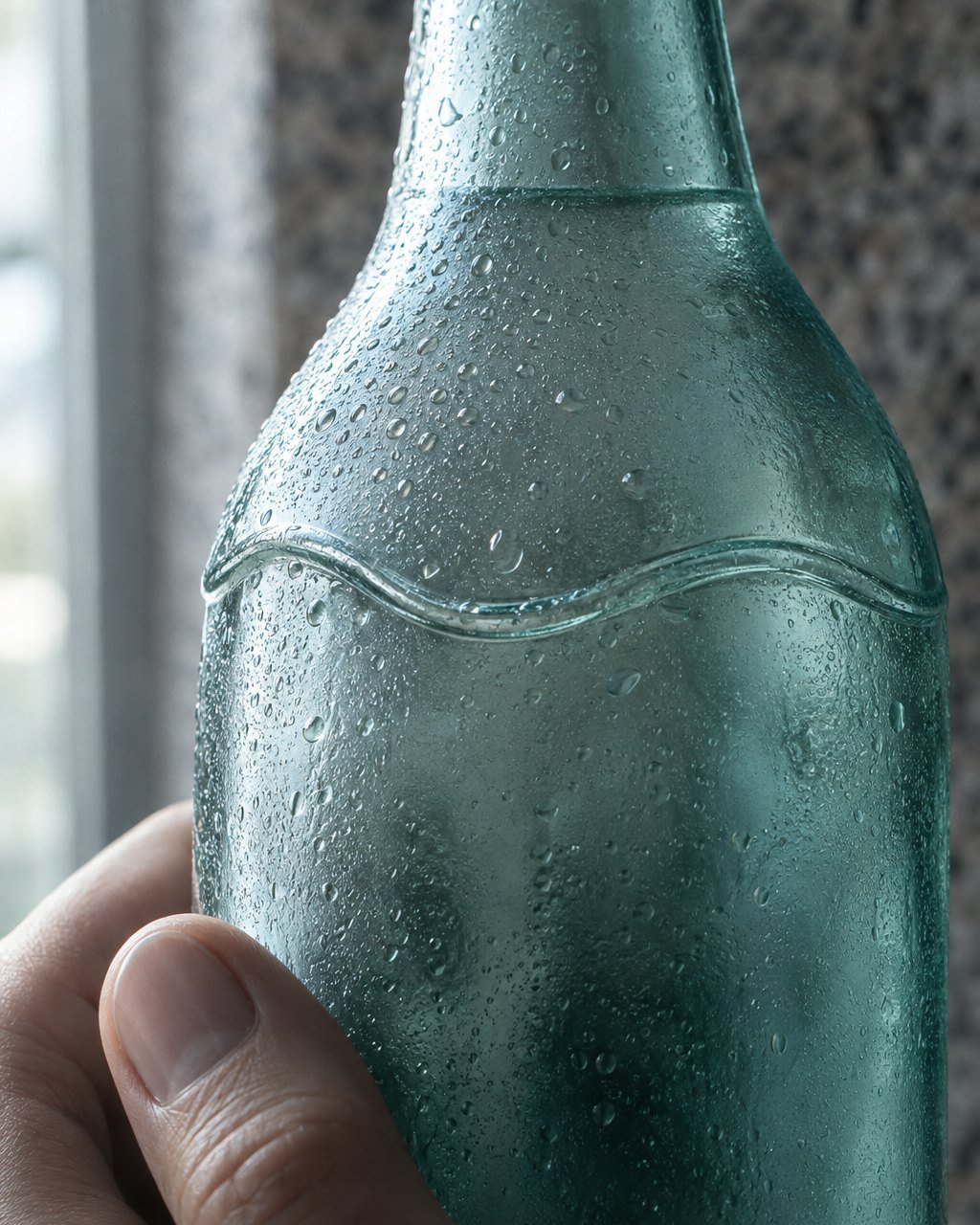
The waveform runs once around the shoulder of every bottle, in relief. Getting it there took three mould samples with Vidros Mondego in Marinha Grande, and a list of things the line had to survive that had nothing to do with how it looked on screen.
- Twenty-five trips through a restaurant washer, so no edge sharp enough to chip or trap grime.
- A filling line running at full speed, where bottles knock together all day.
- A wet thumb in a busy kitchen: at 0.6 mm deep the relief gives grip as well as shape.
- A glance across a table, where it has to read as a pattern, not as a chart.
Most water brands show you a mountain. We wanted you to hear the spring first.
A film with no music
The launch film, “Nascente”, is 45 seconds long and has no music. Every sound in it was recorded at the spring or in the bottling hall: the basin, the line, the crates being stacked, a cap coming off at a table in Porto. The waveform appears once as a moving line, then settles into the glass. The first cut had a score, and it made everything feel like an advert for somewhere else. The opening of the film became the sound identity: the cap, one pulse and the hiss, about two seconds long. It starts every social clip, and Fontela’s distributors play it at trade tastings before anyone pours.
Eight months on
The new bottle went out in April. Fontela is now on the tables of more than a hundred restaurants and hotels that had never stocked it, in Lisbon, Porto and Madrid, and the plastic line closed in the summer. London follows in the spring. Waiters tell Leonor that guests run a thumb over the shoulder before they pour, which is the best review a piece of packaging can get. What I took from it is simple. Sound is one of the cheapest brand assets there is, and one of the least used. Two days with a microphone gave us the bottle, the film, the pattern on the crates and the loading line on the website. It is now the first thing I ask for on any project with a physical place behind it.