




Naming a payments app in thirty days
Four hundred candidates, eleven trademark searches and one word that sounds like money arriving on time.
 Anjali RaoFounder, Creative Director, London
- Kind
- Case note
- Published
- Reading
- 5 min
When Kinro came to us it had a product, 400,000 freelance users and a working name that a larger competitor already used in three of its markets. The investors wanted a new name before the next round closed, which gave us thirty days from kick-off to a name the lawyers were comfortable with. This is roughly how those thirty days went.
Week one: territories before words
Naming goes wrong when it starts with lists. Ask a room for name ideas and you get puns, compound words and the founder’s dog. So the first week is about territories: four or five directions a name could take, each with a reason to exist. For Kinro we agreed five.
- Time: names about punctuality and the moment money lands.
- Arrival: movement, delivery, the end of a journey.
- Craft: the work freelancers do, rather than the money they are paid for it.
- Calm: what it feels like not to chase an invoice.
- Invented: short coined words with no fixed meaning, chosen for sound alone.
Each territory got a one-paragraph rationale and a handful of example words, and the founders ranked them before we generated a single candidate. Time and Invented came out on top, which told us they wanted something ownable rather than descriptive.
Week two: four hundred to sixty
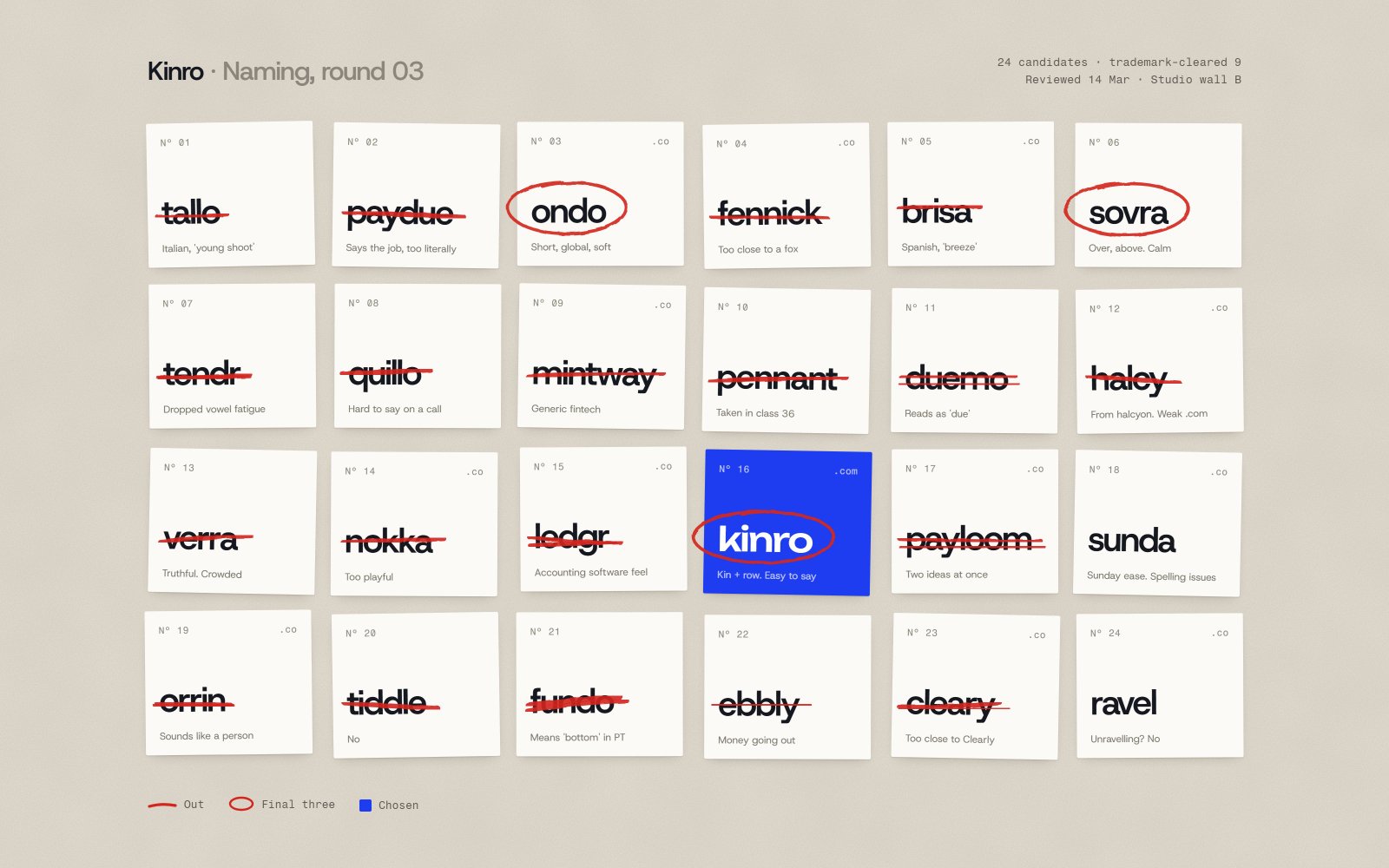
Three of us spent the second week generating names, separately at first, then together. We finished with just over four hundred candidates. Most were not good, which is the point: the good ones only arrive after the obvious ones have been used up.
We cut the list with filters rather than taste. Can you spell it after hearing it once on a bad phone line? Does it survive a sentence, such as “I’ll send it through Kinro”? Is the domain, or a sensible variant, available? Does it mean anything unfortunate in the languages of the eleven countries where Kinro’s users live? We work with a small network of native speakers for that last check, and it removes more names than any other filter.
Week three: the lawyers
Sixty names went to a trademark specialist for knock-out searches in the classes that matter for a payments app: software and financial services. Eleven survived the first pass. Of those, five had problems in at least one key market, which left six to take into the final week.
This is the stage that surprises founders most. Names that feel original almost never are, and a beautiful candidate that cannot be registered is worth nothing. We tell clients to expect to lose their favourite at this point, and to be wary of any naming process that leaves the legal check until after the presentation.
A name read off a slide is judged on its sound. A name read on a notification is judged on whether it works.
Week four: names in context
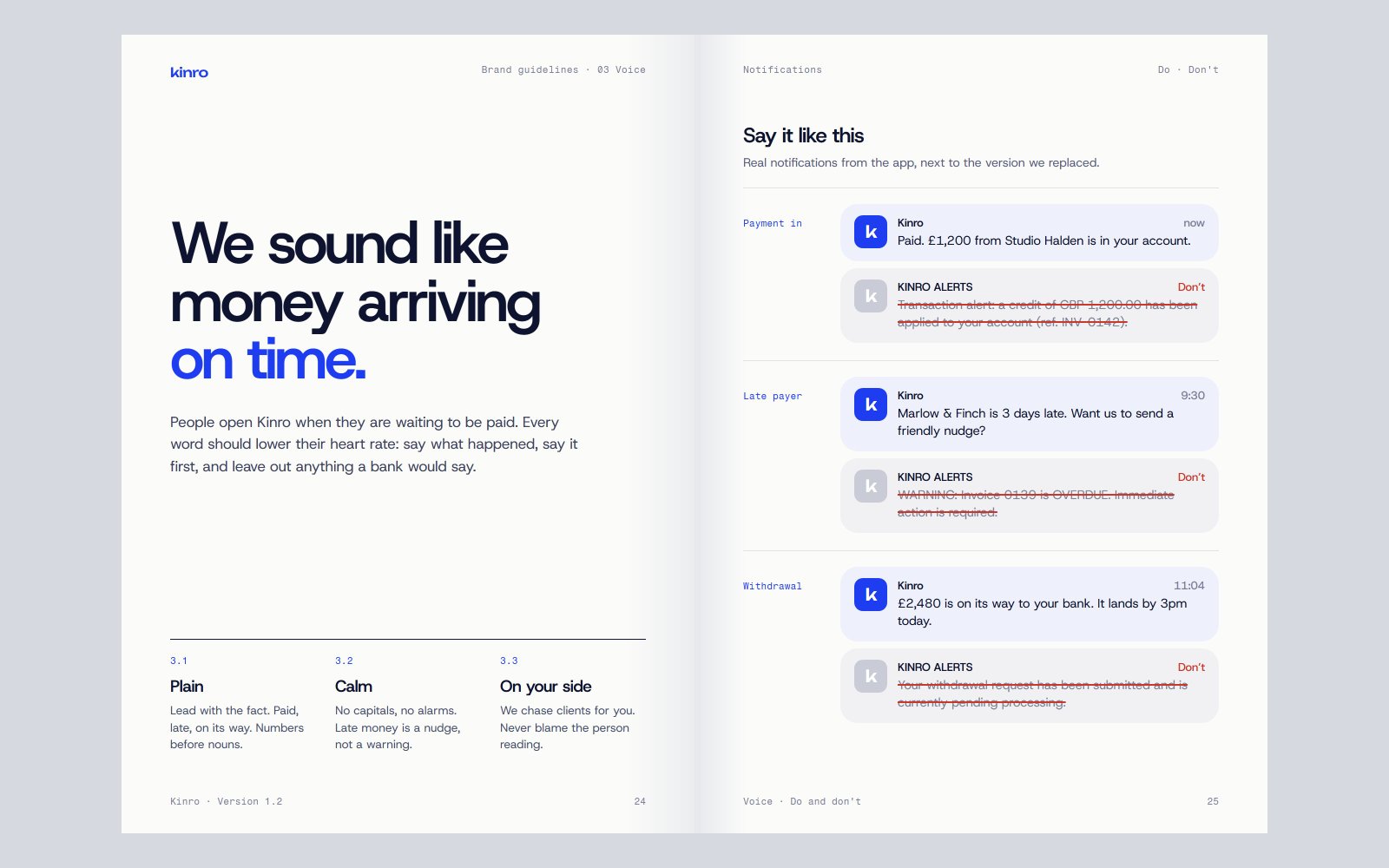
We never present names on their own. Each of the six finalists was set into the places it would actually live: the app icon, a push notification, a line on a bank statement, a receipt, a sentence a freelancer might say to a client.
Kinro won in context. Two syllables, a hard first consonant that carries over a noisy line, and an open vowel at the end that makes it easy to say warmly. “Kinro: £2,480 arrived” reads like good news. One of our Japanese-speaking reviewers pointed out that kin can suggest gold, which we took as a pleasant coincidence rather than a reason.
What we would do again
Thirty days is tight but workable, provided the decision makers are in the room for the territory ranking and the final presentation, and nowhere in between. Most naming projects slip because a new opinion arrives in week three. We agreed with Kinro’s founders that the shortlist would be judged only against the five territories and the filters, not on whether a board member’s partner liked it.
The name went live with the new identity eight weeks later. Sign-ups rose 61 per cent in the following quarter, though most of the credit belongs to the product. A good name does not sell anything by itself. It just stops getting in the way.